Discover Ancient Wisdom for Modern Times
Journey through time with meticulously researched articles and books that bring ancient civilizations to life. Explore philosophies, histories, Pictorials, Videos and traditions that shaped our world and reflections on contemporary issues
Features Pictorials
Our Featured Videos
Featured Books
Handpicked selection of our most popular and highly-rated ebooks
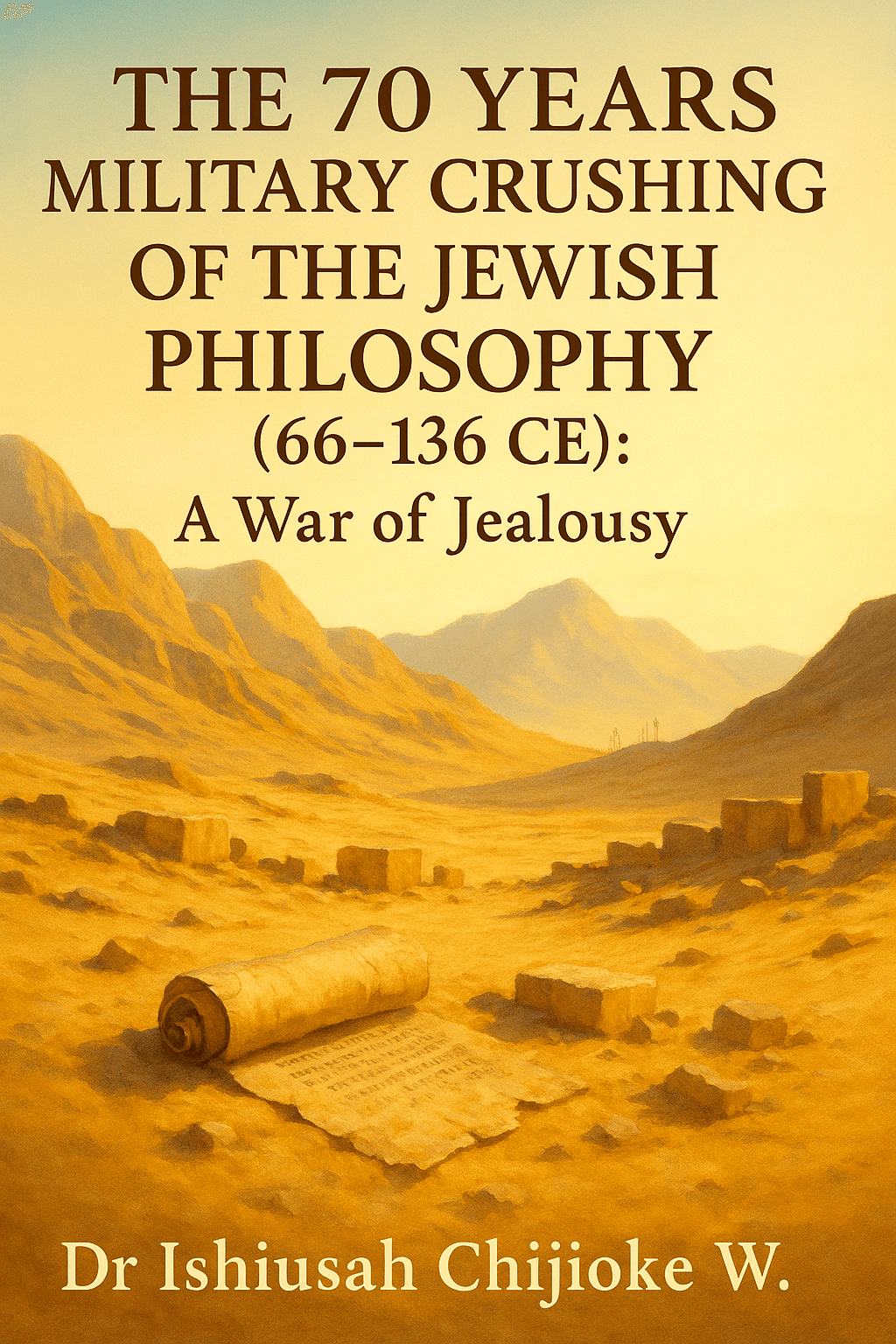
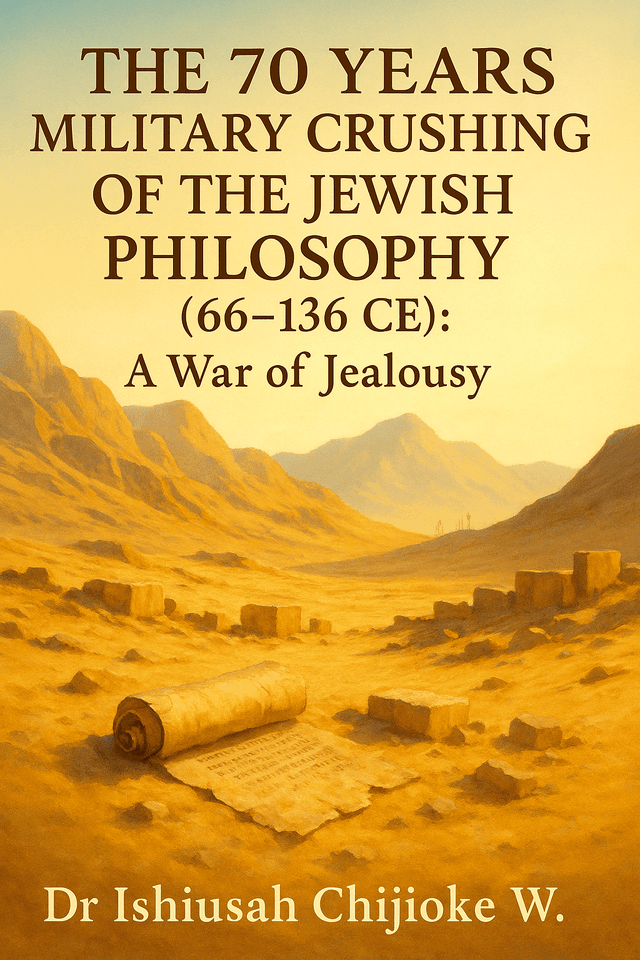
70 Years Military Crushing Of The Jewish Philosophy
NGN 2,000Between 66 and 136 CE, Rome fought not merely to conquer a people, but to silence a philosophy. The 70 Years Military Crushing of the Jewish Philosophy explores this seventy-year conflict—from the fall of Jerusalem to the suppression of Bar Kokhba—as a moral and intellectual struggle between two worldviews. Where Rome sought to replace conscience with order, Israel defended the idea that divine law stands above imperial power. Beneath the battles and ruins, a deeper war unfolded: between faith and empire, memory and administration, revelation and control. Drawing on historical, biblical, and philosophical sources, this work reveals how the destruction of Judea reshaped the moral and spiritual architecture of the West. In the aftermath of conquest, new empires of belief arose, transforming Scripture, history, and the conscience of civilization itself. The 70 Years Military Crushing of the Jewish Philosophy (66–136 CE): A War of Jealousy tells the story of a war that was fought not only with swords and legions, but with ideas, laws, and texts. Covering the tumultuous period from the First Jewish Revolt (66–73 CE) to the Bar Kokhba uprising (132–136 CE), the book argues that Rome’s campaign against Judea was more than a series of provincial rebellions. It was a determined attempt to break the public power of a Jewish moral philosophy that challenged imperial arrogance, religious pluralism, and political idolatry. The “war of jealousy” in the title is Rome’s jealous response to a people whose God claimed absolute loyalty and whose law refused to bow to empire. The book traces three interlocking processes: Military and political crushing – the destruction of Jerusalem, the Temple, and later Judean strongholds; mass killings, enslavement, and expulsions; and the legal measures that tried to erase Jewish public life from the imperial map. The assault on memory and guardianship – the suppression of Jewish schools, teachers, and archives, and the long-term consequences of silencing the Hebrew custodians of revelation. Here, the book explores how Daniel’s warning about changing “times and laws” becomes a historical program aimed at redefining the meaning of Israel’s God, law, and history. The intellectual appropriation and “moderation” of Judaism – the way Greek-speaking philosophers and early Christian theologians absorbed Jewish Scriptures while stripping them from their covenantal framework. The study investigates how key biblical texts, concepts like the Logos, and prophetic promises were reinterpreted through Hellenistic metaphysics and then used to build a new imperial faith. Drawing on the Hebrew Bible, the Septuagint, Second Temple literature, rabbinic sources, Josephus, Philo, Greco-Roman historians, Church Fathers, and modern scholarship, the book follows how: Jewish ethics and prophetic conscience survived defeat but were repackaged into a gentile imperial theology. The God of Israel was gradually recast as a philosophical principle compatible with empire rather than a covenantal Judge of nations. Christianity emerged as a religion that carried Jewish memory in a Greek form, becoming a powerful vehicle for the Romanization of revelation. Rather than treating Judaism and Christianity as purely “religious” systems developing in isolation, this work reads them inside the concrete pressures of empire, military violence, and ideological competition. It shows how theological doctrines are not neutral ideas but often the outcome of political needs, cultural translation, and the loss—or survival—of marginalized voices. Written in accessible language yet grounded in rigorous research, The 70 Years Military Crushing of the Jewish Philosophy invites readers—students, scholars, clergy, and interested non-specialists—to rethink what was really at stake in the first centuries of the Common Era. It asks a simple but unsettling question: when a conquering empire destroys a people’s institutions, silences their teachers, and then claims to speak for their God, what happens to truth, conscience, and justice? This book is that story.
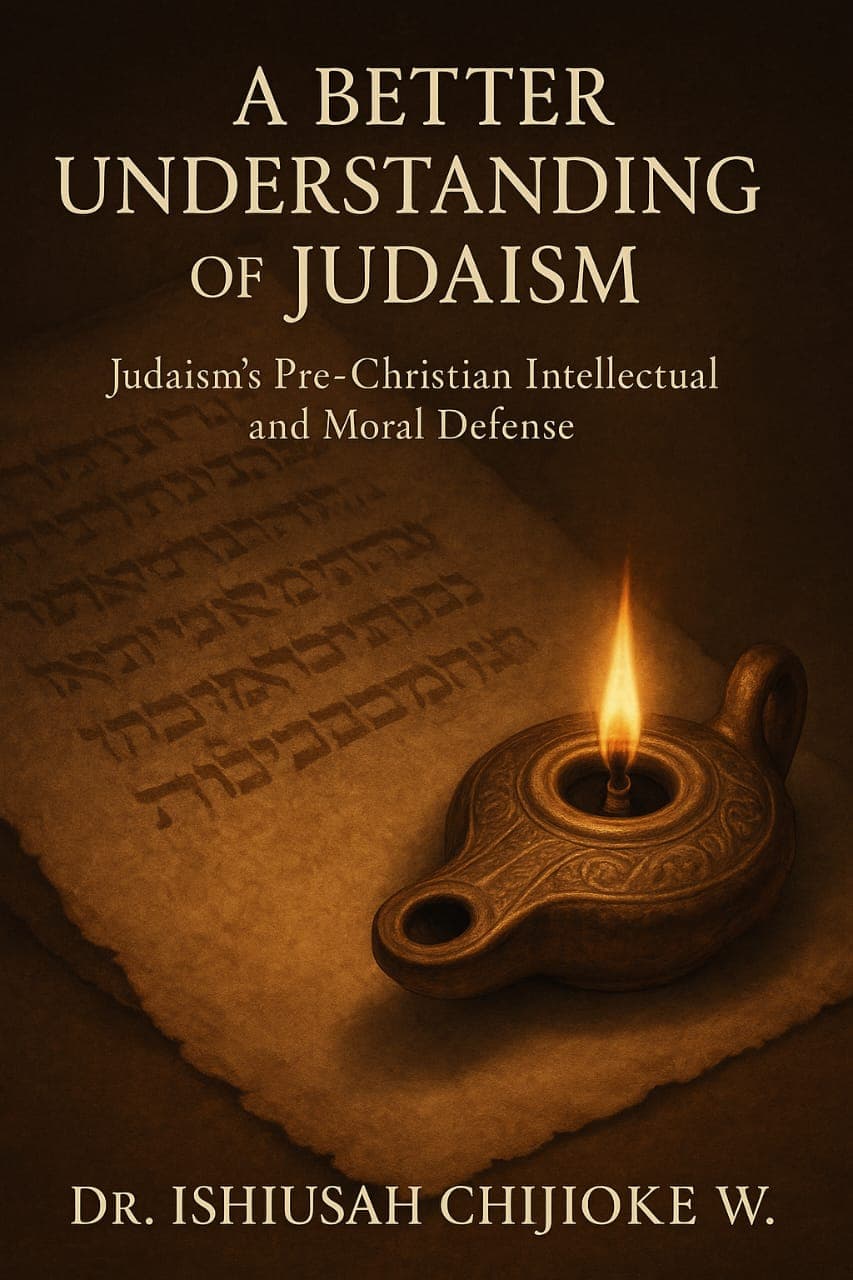
A Better Understanding of Judaism
NGN 2,000Judaism’s Pre-Christian Intellectual and Moral Defense is a guided journey into a world that shaped the conscience of humanity long before the first Christian sermon was preached. It invites readers to meet ancient Judaism not as a shadow behind later religions, but as a fully formed civilization of thought—an intellectual tradition that reasoned about God, argued for justice, and defended moral truth in the face of the greatest empires of the ancient world. For over a thousand years before Christianity emerged, the Jewish people were already engaged in a profound and public struggle: how to live faithfully under foreign powers without losing their spiritual identity, and how to speak about the one God in societies saturated with many gods. This book traces that struggle as a long, deliberate defense of faith through reason, law, ethics, and historical interpretation. It shows that Judaism did not merely survive exile, conquest, and cultural pressure; it responded intelligently to them, producing one of the ancient world’s strongest moral and philosophical foundations. What this book covers The narrative begins in the ancient Near East, where religion was usually transactional and empire-centered, and where moral authority often belonged to kings, priests, or local deities. Against that world, Israel’s faith introduced something radically different: ethical monotheism. The Torah is presented as a rational moral constitution, binding rulers and citizens alike under divine justice. The prophets deepened this vision, insisting that worship without righteousness is empty and that God judges nations by moral standards, not military achievement. From there, the book follows Judaism into exile and Diaspora. When temple and monarchy fell, Jewish life reorganized around Scripture, learning, and practice. Synagogues, scribal scholarship, and portable law became a new spiritual architecture—one that could thrive in Babylon, Persia, Egypt, Asia Minor, and Rome. This portable intellect allowed Judaism to become a global teaching faith long before Christianity carried Jewish ideas outward. A central focus of the book is Jewish engagement with Hellenistic culture after Alexander the Great. Greek philosophy was the dominant intellectual force of the age, and many peoples absorbed it uncritically. Judaism chose a different path: dialogue without surrender. Jewish thinkers translated their Scriptures into Greek, debated philosophical rivals, and demonstrated that the Torah’s moral vision was not inferior to reason but its truest completion. In Alexandria, figures such as Philo embodied this synthesis, arguing in the language of Plato and the Stoics while remaining anchored in the covenant of Moses. By the first century CE, Judaism had produced a mature apologetic civilization capable of speaking convincingly to both insiders and outsiders. Sources and approach This book draws on a wide range of evidence. The Hebrew Scriptures are treated as both sacred texts and historical witnesses to Jewish self-understanding. Alongside them stand non-biblical materials: Second Temple literature (such as the Maccabean writings, Ben Sira, and Wisdom traditions), Jewish historians and philosophers like Josephus and Philo, and testimonies from the broader Greco-Roman world. The purpose is not to overwhelm the reader with technical debates, but to let the historical record speak clearly: Judaism was already intellectually alive, morally confident, and publicly defended before Christianity appeared. The argument is presented in a clear, story-driven way. Instead of treating ideas as abstractions, the book roots them in real historical settings—royal courts, exile communities, philosophical schools, synagogues, marketplaces, and moments of persecution. Readers will see how Jewish moral reasoning was sharpened by crisis, how its defenders answered the claims of polytheism and imperial ideology, and how Jewish faith continued to insist that truth is universal, justice is real, and God is not a tribal possession of any empire. Why this book matters Modern readers inherit a world deeply shaped by biblical ideas—human dignity, moral accountability, the sacredness of life, the critique of tyranny, the hope for redemption. Yet these ideas did not enter history suddenly through Christianity alone. They were cultivated over centuries in Jewish thought and practice, through the Torah’s moral vision, the prophets’ public conscience, the sages’ wisdom, and the Diaspora’s intellectual resilience. Understanding that pre-Christian Jewish achievement restores historical balance. It also helps readers understand the New Testament world more accurately, since early Christianity emerged within—and initially depended on—this already established Jewish intellectual environment. But the relevance is not only historical. The book speaks to contemporary questions as well. In every age, people struggle with the seductions of power, the pressures of cultural conformity, the temptation to reduce religion to superstition or tribalism, and the hunger for a morality grounded in something firmer than fashion. Ancient Judaism faced those issues directly. Its pre-Christian defense shows how a community can remain intellectually open yet spiritually distinct, how faith can reason without losing reverence, and how moral truth can stand against empire without collapsing into violence. Who should read this book This volume is for general readers who care about history, faith, ethics, and the way civilizations are formed by ideas. It is written for those who want to understand Judaism’s role in world history, those who seek a deeper grasp of the moral and intellectual background of Christianity, and those who are simply interested in how ancient peoples argued about God, justice, and the meaning of life. No specialized training is required—only curiosity and a willingness to follow an ancient tradition as it thinks its way through the trials of history. In short, Judaism’s Pre-Christian Intellectual and Moral Defense reintroduces readers to an ancient moral powerhouse: a people who conquered no empires, yet confronted empires with conscience; a faith that built no armies, yet built one of history’s most enduring intellectual legacies. This book restores that legacy to view and invites readers to learn from it again—both for understanding the past and for navigating the moral demands of the present.
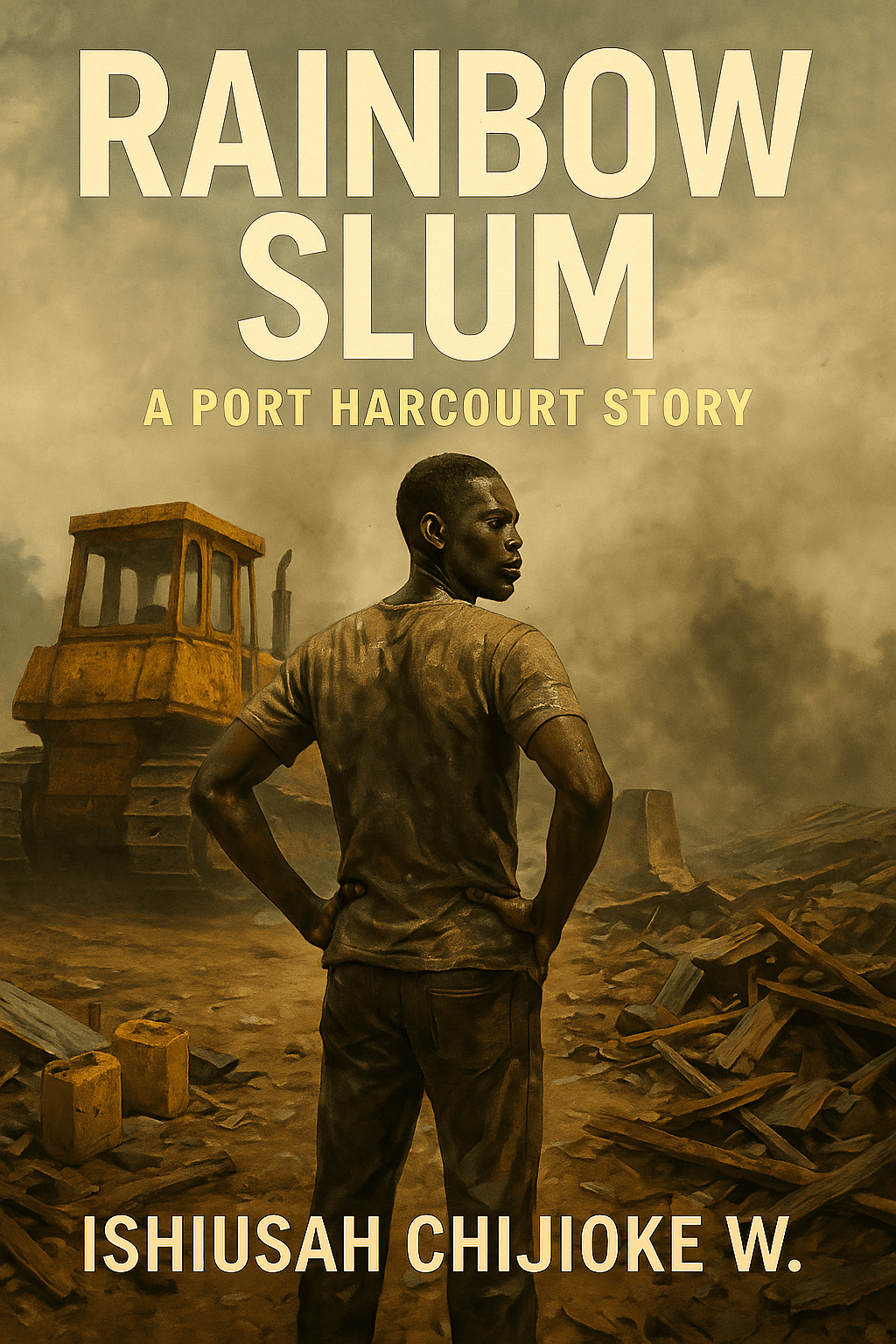
Rainbow Slum
NGN 2,000RAINBOW SLUM: A PORT HARCOURT STORY follows Akpan, a young man who leaves his quiet village for the promise of the city—and instead lands in Rainbow Slum, a forgotten settlement tucked behind the factories of Port Harcourt. Surrounded by zinc shacks, flooded alleys, and daily hustles, he fights his way up from broke newcomer to the unlikely owner of a booming borehole and “toilet empire.” But success in the slum comes at a cost. As Akpan gains money, influence, and admirers, he also makes choices that stain his conscience. Pastors sell miracles, gang leaders sell protection, and officials sell development dreams—until, one morning, bulldozers and armed men arrive to wipe Rainbow Slum off the map. Told with warmth, humour, and unflinching realism, RAINBOW SLUM: A PORT HARCOURT STORY shines a light on the human lives hidden behind the word “slum”—their dreams, failures, loves, betrayals, and stubborn hope. It is a gripping novel of survival, power, and hard-won redemption in a place that officially does not exist, but where every heartbeat counts.
Instant Access
Download immediately after payment confirmation
Secure Payment
Paystack secured payments with multiple options
Any Device
Read on your phone, tablet, or computer
Stay Updated
Get notified about new ebook releases, exclusive discounts, and valuable content.